This section defines a number of terms that are used in this manual.
Corridor
• Corridor
A right-of-way on which line sections are built. The Line Database calculates and reports zero sequence mutual coupling between two lines when they have sections in a common corridor.
Overhead Lines
• Overhead Structure (Tower Type)
A tower or power pole capable of supporting multiple circuits (e.g., a double circuit tower) and ground wires.
• Overhead Construction
A continuous string of the same overhead structure within a corridor. The parameters of an overhead construction are type ID, beginning and end points, and placement offsets.
• Overhead Circuit
A component of an overhead construction. The circuit is a group of power carrying wires for a single-, 2-, or 3-phase circuit. The important parameters of an overhead circuit are the wire type, the x-y position coordinates, and bundling information.
• Ground Wire
A component of an overhead construction. The ground wire is connected to ground at some point. It is also called a shield wire. A construction can have multiple ground wires. The important parameters of a ground wire are the wire type and whether it is segmented or continuous.
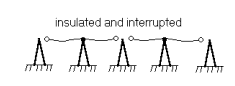
A continuous (unsegmented) ground wire is grounded at every tower. A segmented ground wire is grounded at intervals but is insulated at towers adjacent to the grounding points to prevent circulating currents. See figure below. A segmented ground wire is ignored in the series impedance calculations, but is considered in the shunt-capacitance calculations.
• Bundle
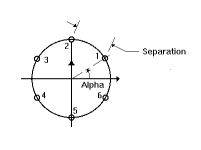
A group of power-carrying wires for the same phase of a circuit. The Line Database can handle regularly spaced bundles. The parameters of a bundle are the number of wires in the bundle, the center-to-center separation and the starting angle (alpha).
• Overhead Line Section
A line is broken up into sections because of (1) phase transpositions, (2) changes in the tower configuration and conductor type, and (3) the need to be on multiple corridors. Each line section must be associated with a circuit of a construction. (It is possible to associate a line section with two or more circuits of a construction. See Section 3.12 OVERHEAD LINE SECTION DATA FORM for details.)
• Transposition
A rotation of the positions of the phase conductors of a multi-phase circuit. In the Line Database, a phase transposition can take place only at the junction between line sections. Long lines are transposed at regular intervals to reduce the asymmetry in phase currents and phase-to-neutral voltages.
• Continuous Transposition
A mathematical assumption made to avoid the asymmetry of an untransposed circuit. The phase wires of a multi-phase circuit are said to be continuously transposed if the phase wires continuously exchange their positions in the direction of travel, such that the wires become homogeneous in terms of the wire-to-wire and wire-to-earth separation.
Underground Cables
• Cable Types
The Line Database supports single- and 3-core cable types.
• Cable Section
The Line Database can handle single-, 2-, and 3-phase cable circuits. The important parameters of a cable section are the cable type and configuration. The sheaths of a single-core cable circuit can be single-point bonded, or solid bonded, or cross bonded.
• Cross Bonding
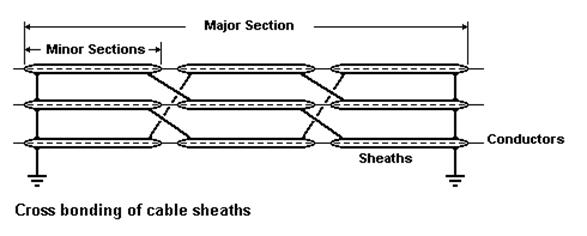
A method to eliminate sheath circulating currents for longer lengths, while holding standing voltages to permissible levels. The circuit must have roughly equal lengths of minor sections in groups of three. Three minor sections constitute a major section. At each end of a major section, the three sheaths are connected together and grounded. At the two intermediate joints of minor sections, the sheaths are electrically transposed.
• Single-Point Bonding
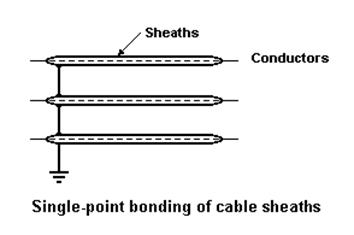
A method to reduce sheath voltage by bonding the three sheaths together and connecting them to the ground at only one point.
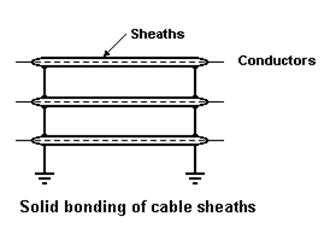
• Solid Bonding
A method to reduce sheath voltage by bonding the three sheaths together and connecting them to the ground at each end of the circuit.
• Single-Core Cable
A cable that has only one core, i.e., a one-phase conductor.
• Three-Core Cable
A cable that has three cores, one for each phase. Pipe-type cables are usually 3-core cables.
Transmission Line
• Section or Line Section
A portion of a transmission line with uniform physical characteristics. Section can be one of three types: overhead line section, underground section, or impedance section.
• Line
A single-, 2- or 3-phase circuit that transmit power from one bus to another. A line can be made up from sections of different types. Each line in the database must be assigned an ID, From and To buses, nominal kV, and ownership code.
• Tap
A marker placed on line section to indicate a tapping point on the line. When exporting line impedance to OneLiner, the user can select whether to include taps in the exported data. If so, the taps are exported as “tap buses” in OneLiner.